A Honda with
nothing to update.
One cylinder, air-cooled, a carburettor, and not a single line of software anywhere on it.
Simple is
a strategy.
Everyone expects the big adventure bike. Twelve hundred cc, three riding modes, heated everything, and a dealer network that ends somewhere around Tbilisi.
Past the Caspian, the electronics that make a modern bike pleasant are exactly the parts nobody can fix. This one has a carburettor, a CDI box and no software. A village mechanic can open it with hand tools and understand what he is looking at.
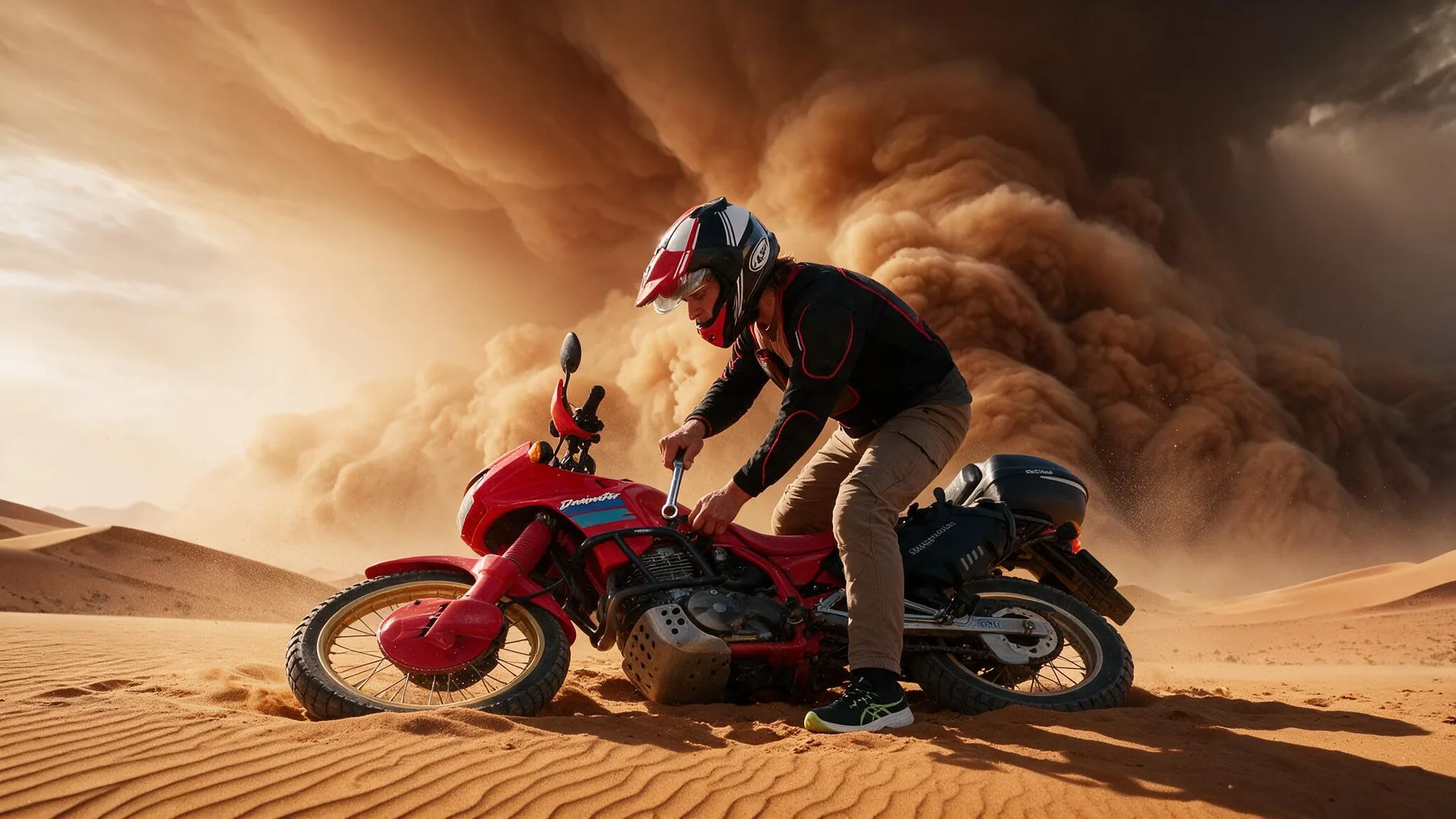
It weighs 178 kilos with fuel in it, about forty less than an Africa Twin. That difference does not sound like much until the third time you pick it up out of sand on your own.
It is not a romantic choice. It is arithmetic.
Twelve years,
two factories,
one engine.
Honda built the Dominator from 1988 to 1999, and it very nearly did not survive its first two years.
It arrived as Honda's answer to the market BMW had opened with the R80G/S: a big trail single made civil enough for the road. In Europe it was the Dominator. In America it was just the NX650, and it lasted two model years before disappearing. Germany sold about a thousand in 1988 against a target of two thousand.
Honda responded by making it cheaper. For 1990 and 1991 the kickstarter went, the rear damping adjuster went, the stainless headers were replaced with plain steel, and even the tank decals were deleted. Owners call those years the budget Dominator.
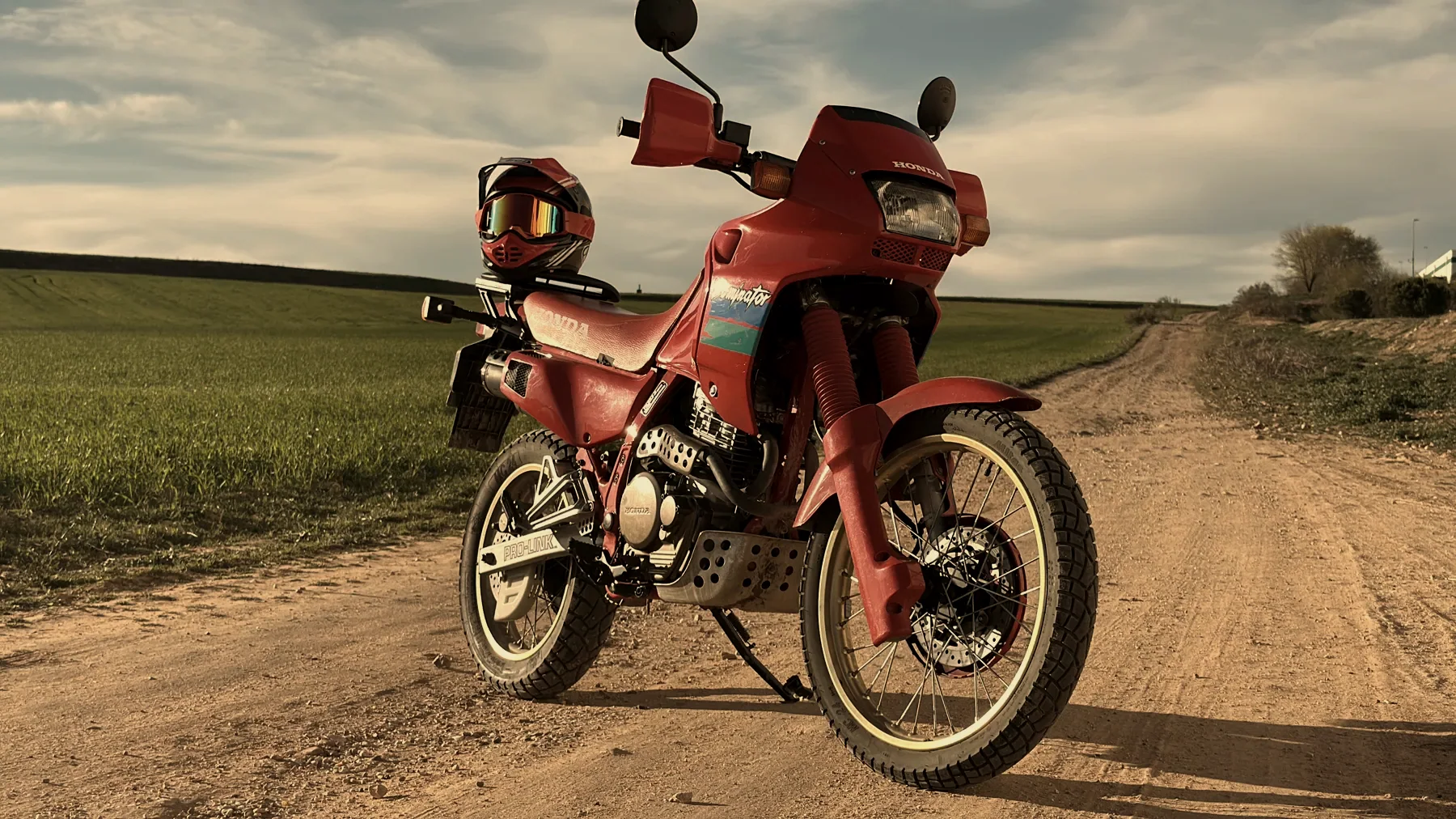
Then in 1992 it went the other way. A bigger fairing with the indicators moulded in, a sixteen-litre tank instead of thirteen, a flush filler cap, and an engine painted silver instead of black. That is the bike I ride.
The generation split is simple once you know it. Bikes from 1988 to 1994 are RD02, built in Japan. From 1995 the frame code becomes RD08 and production moved to Italy, with a reputation for rusting that the Japanese bikes do not have.
The engine barely changed across the whole run. Honda kept stamping RD08 bikes with RD02E engine numbers, which means frame and engine numbers never match and matching-numbers collectors quietly lose their minds.
That engine, a 644 cc RFVC single with four radially arranged valves, came from the XR600R and outlived the Dominator by more than twenty years. It went on into the XR650L, the SLR650, the FX650 Vigor and the FMX650, and Honda was still cataloguing the XR650L in 2022.
You will read that the Dominator descends from the NXR750 that won the Dakar. I could find no primary source for that, and Honda's actual Dakar machine was a different bike entirely. The Dakar-look Dominators you see are customs, not heritage. The name's origin is undocumented too. If somebody tells you what "Dominator" was named after, ask them for the source.
How to spot
a 1992.
Five things, and you never need to ask again.
- Model code
- RD02, type NX650N. Frame number starts RD02-55 on a full-power bike, RD02-35 on a 27 PS restricted one.
- The engine is silver
- Only 1992 to 1994. Everything before it was black.
- Sixteen-litre tank
- Up from thirteen, with a flush filler cap. Most spec databases still print the old figure for this year.
- Indicators in the fairing
- The larger Tour fairing with the lights moulded in, on a revised bracket.
- No heat shields
- The tailpipes lost them this year. The headers are plain steel, not stainless, so they rot.
- No kickstarter
- Deleted after 1989. Electric start only, with an automatic decompressor.
From 1993 the Dominator got the reinforced oil pump from the XR650L, a targeted fix for the oil-supply weakness that killed early engines. Mine is the last year before that upgrade. It is not a reason to panic, it is a reason to be religious about oil level and heat.
Everything,
in numbers.
Factory figures for the 1992 model year. Where the databases disagree with Honda, I have used Honda.
Engine
- Type
- Air-cooled four-stroke single, SOHC, chain-driven cam
- Valve layout
- RFVC, four radially arranged valves
- Displacement
- 644 cm³
- Bore × stroke
- 100 × 82 mm
- Compression
- 8.3 : 1
- Carburettor
- Keihin 40 mm constant vacuum
- Jetting (1992)
- Main 148 / pilot 48 · restricted models main 150
- Ignition
- CDI
- Starting
- Electric only. The kickstarter was deleted after 1989
- Lubrication
- Dry sump. The oil lives in the frame down-tube
- Oil capacity
- 1.9 L at a change · 2.3 L after a rebuild
- Emissions
- SLS secondary-air system, fitted from 1990
Performance
- Power
- 32 kW / 44 PS at 6,000 rpm
- Torque
- 53 Nm at 5,000 rpm
- Restricted version
- 20 kW / 27 PS, with its own frame-number series
- Top speed
- 153 km/h claimed · about 160 km/h timed
- Fuel
- Unleaded, 91 RON minimum
Transmission
- Gearbox
- Five-speed constant mesh
- Clutch
- Wet multiplate, cable operated
- Primary reduction
- 2.029 (69/34)
- Final drive
- 520 O-ring chain, 108 to 110 links
- Sprockets (1992)
- 15 front / 47 rear
Chassis
- Frame
- Steel semi-double cradle. The front down-tube is the oil tank
- Front suspension
- Showa 41 mm leading-axle fork, 220 mm travel, no adjustment
- Rear suspension
- Showa Pro-Link monoshock, 195 mm travel, preload only
- Front brake
- 256 mm disc, Nissin twin-piston floating caliper
- Rear brake
- 220 mm disc, single-piston floating caliper
- Wheels
- Wire spoke, 21 in front / 17 in rear
- Tyres
- 90/90-21 front · 120/90-17 rear
- Rake / trail
- 28°30′ · 117 mm
Dimensions
- Length × width × height
- 2,195 × 890 × 1,220 mm
- Wheelbase
- 1,435 mm
- Ground clearance
- 255 mm
- Seat height
- About 870 mm
- Fuel capacity
- 16 L including 2.5 L reserve, new for 1992
- Weight
- 163 kg dry · 178 kg wet
Electrics and service
- Alternator
- 180 W at 5,000 rpm
- Battery
- 12 V 8 Ah, YTX9-BS
- Spark plug
- NGK DPR8EA-9, gap 0.8 to 0.9 mm
- Valve clearance, cold
- Inlet 0.10 mm · exhaust 0.12 mm
- Service interval
- Every 6,000 km
- Engine oil
- SAE 10W-40, API SE/SF or better
- Fork oil
- 592 cm³ per leg, SAE 10W
- Tyre pressure
- 1.5 bar front and rear solo · 2.0 bar rear loaded
Worth knowing
even if you
own one.
The frame is the oil tank
It is dry sump, and the oil is carried in the front down-tube. That means two drain plugs, one in the sump and one on the tube under the header. Drain only the sump and most of the old oil stays in the bike.
Honda quietly changed its own instructions
In 1993 Honda extended the run-the-engine-first time before checking oil from two or three minutes to five, because the shorter time gave a false high reading. Owners following the printed manual could be running dangerously low.
1992 is the only year the engine was silver
Along with the flush filler cap and the tailpipes stripped of their heat shields, it is the one-look identifier of the 1992 to 1994 facelift. Earlier engines were black.
The tank grew by three litres this year
Sixteen litres from 1992, up from thirteen. Almost every spec database still lists the old figure for this model year. They are wrong.
It is the last year before the better oil pump
From 1993 the Dominator got the reinforced XR650L oil pump. Mine is the year before, which is worth knowing rather than pretending otherwise.
RD08 Dominators still have RD02 engines
Honda kept stamping engines RD02E right through the later generation because the powerplant barely changed. Frame and engine numbers never match, which drives matching-numbers collectors up the wall.
There was a deliberately decontented Dominator
For 1990 and 1991 Honda deleted the kickstarter, the rear damping adjuster, the stainless headers and even the tank decals to hold the price. About 1,900 were sold in two years.
It flopped when new
Roughly a thousand sold in Germany in 1988 against a two-thousand target, and unsold stock was carried into the next year. In America it lasted two model years and vanished.
American bikes had a rear drum brake
Honda's own parts catalogue for the 1989 US model lists a rear brake panel and no rear caliper at all. European bikes had a 220 mm rear disc from the start.
The engine outlived the bike by decades
The same 100 × 82 mm single went into the XR650L, the SLR650, the FX650 Vigor and the FMX650. Honda was still cataloguing the XR650L in 2022.
What it is,
honestly.
- Year and code
- 1992 · RD02 · NX650N
- Colour
- Red, with the silver engine that only these years had
- Luggage
- Top box and soft panniers. Nothing bolted on that cannot come off in a minute.
- Done so far
- Bought, ridden, and dropped. In that order.
- Next
- Suspension and tyres, then a bash plate, then a hard look at everything carrying fuel or spark
- Before Mongolia
- A bigger tank. Sixteen litres is about 250 km, and Central Asia does not care how brave you are
- Expected to break
- Something electrical, somewhere inconvenient. It always is.
The ones
people ask.
Is a 1992 Dominator actually up to riding to Mongolia?
Yes, with two changes almost everyone makes: a bigger tank and a better rear shock. Sixteen litres gives roughly 240 to 265 kilometres, which is thin for Central Asia. The standard fix is a 22-litre Acerbis tank. The rear shock sags under luggage, and a Hagon or YSS unit with a stiffer spring is the single most transformative thing you can do to the bike.
What actually goes wrong with these engines?
The one genuine design weakness is the valve seats. They are cast bronze, they can work loose at high mileage, and a dropped seat wrecks the head. The symptom is sudden loud clattering that valve adjustment does not fix. Everything else on the list, such as cam chain rattle, a cracked inlet rubber, a tired regulator or stator, is wear and neglect rather than a flaw. Ridden cool and kept in oil, the engine is good for well over 100,000 miles.
Why not just buy something modern?
Past the Caspian, the electronics that make a modern bike pleasant are the parts nobody can fix. This one has a carburettor, a CDI box and no software. A village mechanic can open it with hand tools and understand what he is looking at. And at 178 kilos wet it is about forty kilos lighter than an Africa Twin, which matters every single time it goes over.
How do you check the oil on a dry-sump bike?
Run it to temperature, stop, let it idle twenty seconds, then measure immediately with the bike upright and the dipstick resting rather than screwed in. Get it wrong and you can be running on half a litre. Honda extended the warm-up guidance to five minutes in 1993 for exactly this reason.
Is the subframe really as weak as people say?
This one is genuinely disputed. Overlanders will tell you it bends and then breaks under heavy luggage. Experienced mechanics point out the frame is gusseted and say they have never seen real evidence. The practical answer both camps agree on: run soft luggage on light rails and do not hang hard cases off the back.
What does 1992 mean specifically?
It is an RD02, the first year of the Tour facelift. Sixteen-litre tank, flush filler cap, a larger fairing with the indicators moulded in, no heat shields on the tailpipes, and a silver engine. No kickstarter, 32 kW, and 15/47 gearing. The frame number starts RD02-55 for a full-power bike.
How often does it need attention?
Every 6,000 kilometres on paper, and the community sensibly halves the oil interval to 3,000. Valves get checked at the same service, cold, at 0.10 inlet and 0.12 exhaust. It is an hour of work, not a workshop visit, and that is rather the point.
Manuals,
brochures,
part numbers.
Everything below is either Honda's own or a community archive. Links open in a new tab.
Scanned copies of Honda's factory service manual are all over the internet for free. They are unauthorised copies of a copyrighted book, so they are not linked here. The legitimate routes are the genuine Honda manual, print code 61MN901, through a dealer, or the Bucheli aftermarket repair manual number 5206. Both cost money, and both are worth it if you are going to open the engine.
Filmed as
it happens.
Everything done to this bike between now and Mongolia goes on camera, including the parts I get wrong. If a modification turns out to be a mistake, that episode gets made too.
Follow the build